
焊接防护服标准GB-15701-1995JZO完整文件免费下载
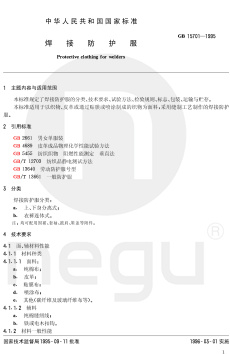
焊接防护服涵盖阻燃防护服,指的是以织物、皮革或通过贴膜和喷涂铝等物质制成的织物面料、并采用缝制工艺制作的、以防御焊接时的熔融金属、火花和高温灼烧人体的防护类服装。
焊接防护服标准GB--15701-1995JZO(以下简称该标准)属于中华人民共合作国家标准下属范畴,由国家技术监督局1995-09-11批准,1996-03-01起实施。
一、主题内容与适用范围
该标准规定了焊接防护服的分类、技术要求、试验方法、检验规则、标志、包装、运输与贮存。适用于以织物、皮革或通过贴膜或喷涂制成的织物为面料,采用缝制工艺制作的焊接防护服。
二、引用标准
GB 4689 皮革成品物理化学性能试验方法
GB 5455 纺织织物 阻燃性能测定 垂直法
GB/T 12703 纺织品静电测试方法
GB 13640 劳动防护服号型
GB/T 13661 一般防护服
GB 2661 男女单服装
三、分类
该标准将焊接防护服分为两类:
1.上、下身分离式;
2.衣裤连体式。
注:均可配用围裙、套袖、披肩、鞋盖等附件。
四、技术要求、
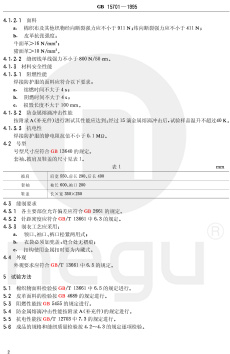
该标准对焊接防护服的面、辅材料性能、材料种类、辅料(包括缝纫线和纽扣材质)的性能作出了明确的参数要求。包括面料的阻燃性能、抗撕裂性、防金属熔滴冲击性、抗电性,以及辅料的强力、材质、阻燃性、号型、缝制要求、外观等都作出了明确的规定。
五、试验方法
1.棉织物面料检验按GB/T 13661中6.5的规定进行。
2. 皮革面料的检验按GB 4689的规定进行。
3. 阻燃性能按GB 5455的规定进行。
4 .防金属熔滴冲击性能按附录A(补充件)的规定进行。
5. 抗电性能按GB/T 12703中7.3的规定进行。
6. 成品的规格和缝纫质量检验按4.2~4.3的规定逐项检验。
六、检验规则
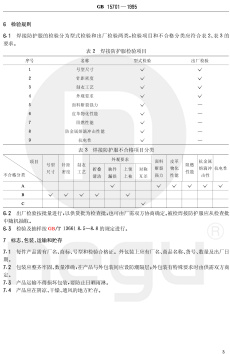
1. 焊接防护服的检验分为型式检验和出厂检验两类,检验项目和不合格分类应符合表2、表3的要求。
2. 出厂检验按批量进行,以供货批为检查批,也可由厂需双方协商确定。被检焊接防护服应从检查批中随机抽取。
3. 检验及抽样按GB/T 13661 8.5~8.8的规定进行。
七、 标志、包装、运输和贮存
1 .每件产品需有厂名、商标、号型和检验合格证。外包装上应有厂名、商品名称、货号、数量及出厂日期。
2. 包装应整齐牢固、数量准确,在产品与外包装间应设防潮隔层;外包装有特殊要求时由供需双方商定。
3 .产品运输不得损坏包装,要防止日晒雨淋。
4. 产品应在阴凉、干燥、通风的地方贮存。
由于篇幅缘故,耐戈小编暂将焊接防护服的标准GB-15701-1995JZO以概述的形式阐述到这里,如果有该方面需求的朋友,可以到耐戈友的官方网站联系客服索要。当然,耐戈友自身生产的该类产品(阻燃防护服,防电弧服,反光防护服等)也是严格遵照此标准以及其他国标、欧标来进行设计生产的。
附加说明:
本标准由中华人民共和国劳动部提出。
本标准由全国劳动防护用品标准化技术委员会归口。
本标准由冶金部建筑研究总院负责起草。
本标准主要起草人洪军、白孝良。
免费下载地址:http://www.negu.com.cn/download/GB15701-1995JZO.pdf
下一篇:一般防护服标准GB/T13661-1992 本文由耐戈友整理发布,转载请注明出处!
BS EN 1149-5-2008-Protective clothing —Electrostatic properties (防护服-防静电服英国/欧洲标准)
Material performance anddesign requirements
ICS 13.340.10
BS EN 1149-5:2008
This British Standard was
published under the authority
of the Standards Policy and
Strategy Committee
on 31 March 2008
© BSI 2008
ISBN 978 0 580 54878 9
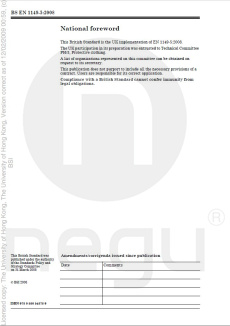
National foreword
This British Standard is the UK implementation of EN
1149-5:2008.
The UK participation in its preparation was entrusted to
Technical Committee
PH/3, Protective clothing.
A list of organizations represented on this committee can
be obtained on
request to its secretary.
This publication does not purport to include all the
necessary provisions of a
contract. Users are responsible for its correct
application.
Compliance with a British Standard cannot
confer immunity from
legal obligations.
Amendments/corrigenda issued since
publication
Date Comments
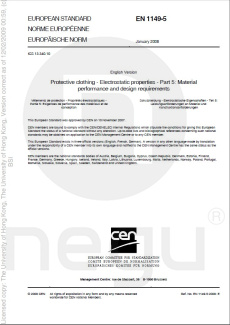
EUROPEAN STANDARD
NORME EUROPÉENNE
EUROPÄISCHE NORM
EN 1149-5
January 2008
ICS 13.340.10
English Version
Protective clothing - Electrostatic properties - Part 5: Material
performance and design requirements
Vêtements de protection - Propriétés électrostatiques -
Partie 5: Exigences de performance des matériaux et de
conception
Schutzkleidung - Elektrostatische Eigenschaften - Teil 5:
Leistungsanforderungen an Material und
Konstruktionsanforderungen
This European Standard was approved by CEN on 10 November 2007.
CEN members are bound to comply with the CEN/CENELEC Internal Regulations
which stipulate the conditions for giving this European
Standard the status of a national standard without any alteration.
Up-to-date lists and bibliographical references concerning such national
standards may be obtained on application to the CEN Management Centre or
to any CEN member.
This European Standard exists in three official versions (English, French,
German). A version in any other language made by translation
under the responsibility of a CEN member into its own language and
notified to the CEN Management Centre has the same status as the
official versions.
CEN members are the national standards bodies of Austria, Belgium,
Bulgaria, Cyprus, Czech Republic, Denmark, Estonia, Finland,
France, Germany, Greece, Hungary, Iceland, Ireland, Italy, Latvia,
Lithuania, Luxembourg, Malta, Netherlands, Norway, Poland, Portugal,
Romania, Slovakia, Slovenia, Spain, Sweden, Switzerland and United
Kingdom.
EUROPEAN COMMITTEE
FOR STANDARDIZATION
COMITÉ EUROPÉEN DE
NORMALISATION
EUROPÄISCHES
KOMITEE FÜR NORMUNG
Management
Centre: rue de Stassart, 36 B-1050 Brussels
© 2008 CEN All rights of exploitation in any form and by any means
reserved
worldwide for CEN national Members.
Ref. No. EN 1149-5:2008: E
由于BS EN 1149-5-2008_防静电服英国/欧洲标准篇幅过长的缘故,耐戈友小编暂将简介内容概述如上,如有网友有兴趣了解关于该标准的完整版本信息,请联系耐戈友网站客服索要。
下一篇:BS EN 533-1997_阻燃防护服英国/欧洲标准 本文由耐戈友整理发布,转载请注明出处!
链接地址 http://www.negu.com.cn/?article-186.html
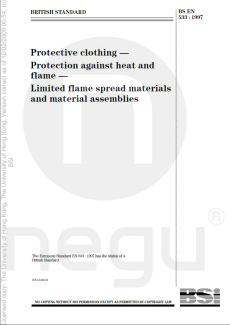
BS EN 533-1997_Protective clothing -Protection against heat andflame -Limited flame spread materials and material assemblies(防护服-阻燃防护服英国/欧洲标准)
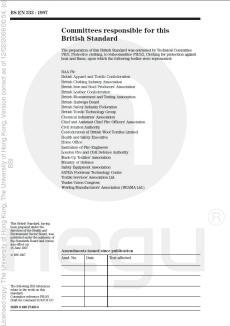
Committees responsible for this
British Standard
The preparation of this British Standard was entrusted by Technical Committee
PH/3, Protective clothing, to Subcommittee PH/3/2, Clothing for protection against
heat and flame, upon which the following bodies were represented:
BAA Plc
British Apparel and Textile Confederation
British Clothing Industry Association
British Iron and Steel Producers' Association
British Leather Confederation
British Measurement and Testing Association
British Railways Board
British Safety Industry Federation
British Textile Technology Group
Chemical Industries' Association
Chief and Assistant Chief Fire Officers' Association
Civil Aviation Authority
Confederation of British Wool Textiles Limited
Health and Safety Executive
Home Office
Institution of Fire Engineers
London Fire and Civil Defence Authority
Made-Up Textiles' Association
Ministry of Defence
Safety Equipment Association
SATRA Footwear Technology Centre
Textile Services' Association Ltd.
Trades Union Congress
Welding Manufacturers' Association (BEAMA Lt.)
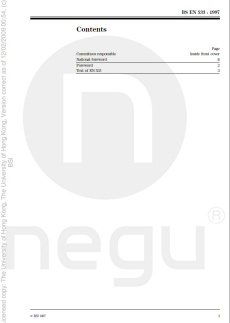
BS EN 533 : 1997
Ó BSI 1997 i
National foreword
This British Standard has been prepared by Subcommittee PH/3/2 and is the English
language version of EN 533 : 1997 Protective clothing Ð Protection against heat and
flame Ð Limited flame spread materials and material assemblies published by the
European Committee for Standardization (CEN). It supersedes BS 6249 : Part 1 : 1982,
which is withdrawn.
NOTE. International and European Standards, as well as overseas standards, are available from
Customer Services, BSI, 389 Chiswick High Road, London W4 4AL.
Compliance with a British Standard does not of itself confer immunity
from legal obligations.
Summary of pages
This document comprises a front cover, an inside front cover, pages i and ii, the EN
title page, pages 2 to 6, an inside back cover and a back cover.
CEN
European Committee for Standardization
Comite EuropeÂen de Normalisation
EuropaÈisches Komitee fuÈ r Normung
Central Secretariat: rue de Stassart 36, B-1050 Brussels
Ó 1997 Copyright reserved to CEN members
Ref. No. EN 533 : 1997 E
EUROPEAN STANDARD EN 533
NORME EUROPEÂENNE
EUROPAÈ ISCHE NORM January 1997
ICS 13.340.10
Descriptors: Personal protective equipment, protective clothing, heat protection, fire resistant materials, specifications, tests,
flame propagation, marking
English version
Protective clothing Ð Protection against heat and flame Ð Limited
flame spread materials and material assemblies
VeÃtements de protection Ð Protection contre la
chaleur et la flamme Ð MateÂriaux et assemblages
de mateÂriaux aÁ propagation de flamme limiteÂe
Schutzkleidung Ð Schutz gegen Hitze und
Flammen Ð Materialien und
Materialkombinationen mit begrenzter
Flammenausbreitung
This European Standard was approved by CEN on 1996-11-07. CEN members are
bound to comply with the CEN/CENELEC Internal Regulations which stipulate the
conditions for giving this European Standard the status of a national standard
without any alteration.
Up-to-date lists and bibliographical references concerning such national standards
may be obtained on application to the Central Secretariat or to any CEN member.
This European Standard exists in three official versions (English, French, German).
A version in any other language made by translation under the responsibility of a
CEN member into its own language and notified to the Central Secretariat has the
same status as the official versions.
CEN members are the national standards bodies of Austria, Belgium, Denmark,
Finland, France, Germany, Greece, Iceland, Ireland, Italy, Luxembourg, Netherlands,
Norway, Portugal, Spain, Sweden, Switzerland and United Kingdom.
由于篇幅缘故,关于BS EN 533-1997_阻燃防护服的英国/欧洲标准,耐戈友小编暂将简介内容概述如上,完整版本防护服标准信息,请联系耐戈友网站客服索要。
下一篇:BS EN 343-2003+A1-2007防雨防护服英国|欧洲标准 本文由耐戈友整理发布,转载请注明出处!
链接地址 http://www.negu.com.cn/?article-185.html
.
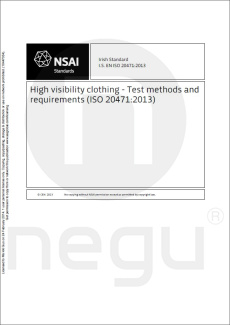
ISO 20471-2013
High Visibility Clothing - Test Methods and Requirements
(高可视性警示服的测试方法及要求)
Foreword
ISO (the International Organization for Standardization) is a worldwide federation of national standards bodies (ISO member bodies). The work of preparing International Standards is normally carried out through ISO technical committees. Each member body interested in a subject for which a technical committee has been established has the right to be represented on that committee. International organizations, governmental and non-governmental, in liaison with ISO, also take part in the work. ISO collaborates closely with the International Electrotechnical Commission (IEC) on all matters of electrotechnical standardization.
International Standards are drafted in accordance with
the rules given in the ISO/IEC Directives, Part 2.
The main task of technical committees is to prepare
International Standards. Draft International Standards adopted by the technical
committees are circulated to the member bodies for voting. Publication as an
International Standard requires approval by at least 75 % of the member
bodies casting a vote.
Attention is drawn to the possibility that some of the
elements of this document may be the subject of patent rights. ISO shall not be
held responsible for identifying any or all such patent rights.
ISO 20471 was prepared by Technical Committee ISO/TC 94, Personal safety — Protective clothing and equipment, Subcommittee SC 13, Protective clothing.
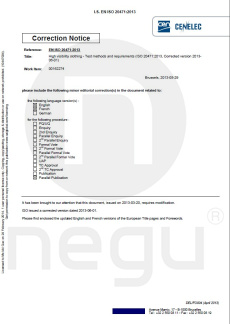
This corrected version of ISO 20471:2013 incorporates the
following correction:
· — in the fourth paragraph of subclause 4.1 the requirement
concerning the sleeves of a class 3 garment has been corrected.
Introduction
The performance of the conspicuity-enhancing materials to
be used for high risk-related visibility clothing is specified photometrically
together with minimum areas and placement (design) requirements.
Conspicuity is the property that makes an object readily
attract visual attention. This is a particularly important feature in complex
environments which have visually competing objects. Conspicuity is determined
by an object’s luminance contrast, colour contrast, pattern and design, and
motion characteristics relative to the ambient background against which it is
seen.
Three classes of garment are defined based on three
different minimum areas of retroreflective, fluorescent and/or combined
performance materials. Each of these classes will provide a different level of
conspicuity, class 3 being the class that provides the highest degree of
conspicuity against most backgrounds found in urban and rural situations in
daylight and in night time. Users should select the required class of
performance based on a risk assessment of the location/situation in which the
protection afforded by clothing to this International Standard is required.
This International Standard contains requirements
relating to risk assessment and risk analysis of high visibility garments.
Possible designs illustrating the placement of retroreflective materials are
included within the standard. Ergonomic factors such as fit/sizing, comfort,
and range of motion of the wearer should be considered when selecting the most
appropriate configuration of retroreflective and fluorescent materials within
the garment.
Selection and use of high visibility clothing can vary
among user countries and may be subject to local regulations. This
International Standard contains requirements relating to risk assessment of the
condition in which the high visibility clothing is to be used. This will involve
consideration of the factors which may affect an observer’s ability to detect
that a person is present. The observer needs both to perceive and to recognize
the wearer and then needs to be able to take appropriate avoidance action. The
wearing of a conspicuity-enhancing high visibility garment does not guarantee
that the wearer will be visible under all conditions.
The minimum requirements given within this International
Standard are determined by the specific test methods and their assigned
measuring values. The tests are partly performed on new materials and partly on
preconditioned materials. By preconditioning (e.g. folding of retroreflective
material) a load of the materials is simulated. However, it should be noted
that laboratory testing may not represent real life conditions. The conspicuity
performance of a garment will depend on usage (e.g. dirt, solar irradiation),
care (e.g. cleaning agent, repair), storage (e.g. dust-free, lightproof), etc.
1 Scope
This International Standard specifies requirements for
high visibility clothing which is capable of visually signalling the user's
presence. The high visibility clothing is intended to provide conspicuity of
the wearer in any light condition when viewed by operators of vehicles or other
mechanized equipment during daylight conditions and under illumination of
headlights in the dark. For further information concerning risk situations, see Annex A.
This International Standard is not applicable to
medium-risk and low-risk situations.
Performance requirements are included for colour and
retroreflection as well as for the minimum areas and for the placement of the
materials in protective clothing.
2 Normative
references
The following referenced documents are indispensable for the application of this document. For dated references, only the edition cited applies. For undated references, the latest edition of the referenced document (including any amendments) applies.
ISO 105-A02, Textiles — Tests for colour fastness — Part A02: Grey scale for assessing change in colour
ISO 105-A03, Textiles — Tests for colour fastness — Part A03: Grey scale for assessing staining
ISO 105-B02:1994, Textiles — Tests for colour fastness — Part B02: Colour fastness to artificial light: Xenon arc fading lamp test
ISO 105-C06, Textiles — Tests for colour fastness — Part C06: Colour fastness to domestic and commercial laundering
ISO 105-D01, Textiles — Tests for colour fastness — Part D01: Colour fastness to drycleaning using perchloroethylene solvent
ISO 105-E04, Textiles — Tests for colour fastness — Part E04: Colour fastness to perspiration — Part E04: Colour fastness to perspiration
ISO 105-N01, Textiles — Tests for colour fastness — Part N01: Colour fastness to bleaching: Hypochlorite — Tests for colour fastness — Part N01: Colour fastness to bleaching: Hypochlorite
ISO 105-X11, Textiles — Tests for colour fastness — Part X11: Colour fastness to hot pressing — Tests for colour fastness — Part X11: Colour fastness to hot pressing
ISO 105-X12, Textiles — Tests for colour fastness — Part X12: Colour fastness to rubbing
EN 343, Protective clothing — Protection against rain
CIE 15, Colorimetry
CIE 54.2, Retroreflection — Definition and measurement
3 Terms
and definitions
For the purposes of this document, the following terms
and definitions apply.
3.1
high visibility clothing
warning clothing intended to provide improved conspicuity
in situations where the risk of not being seen is high
3.2
fluorescent material
material that emits electromagnetic radiation at visible
wavelengths longer than those absorbed
3.3
background material
coloured fluorescent material intended to be highly
conspicuous, but not intended to comply with the requirements of this International
Standard for retroreflective material
3.4
retroreflective material
material which is a retroreflector but which is not
intended to comply with the requirements of this International Standard for
background material
3.5
separate-performance material
material intended to exhibit either background or
retroreflective properties but not both
3.6
combined-performance material
material intended to exhibit both background and
retroreflective properties
3.7
orientation-sensitive material
material having coefficients of retroreflection that
differ by more than 15 % when measured at the two rotation angles ε1 = 0° and ε2 = 90°
3.8
torso
thorax and abdomen or section of the body to which the
limbs, head and neck are attached
3.9
long sleeve
(1/1 arm)
part of a garment that is completely covering the arm
3.10
road
traffic-related area with moving vehicles
EXAMPLE:
Cycling path, harbour, airport, railway track and car
park.
3.11
active road user
person on the road, participating in the traffic and with
the attention on the traffic
Note 1 to entry: e.g. cyclist using the road and pedestrian
using the road.
3.12
passive road user
person on the road, not participating in vehicular
traffic and with attention focused on something other than traffic
EXAMPLE:
Road worker, person in emergency situation.
3.13
outer shell
outermost material of which the warning clothing is made
Bibliography
|
ISO 3175-2, Textiles — Professional care,
drycleaning and wetcleaning of fabrics and garments — Part 2:
Procedure for testing performance when cleaning and finishing using
tetrachloroethene |
|
|
ISO 3758, Textiles — Care labelling code
using symbols |
|
|
ISO 3759, Textiles — Preparation,
marking and measuring of fabric specimens and garments in tests for
determination of dimensional change |
|
|
ISO 6330, Textiles — Domestic washing
and drying procedures for textile testing |
|
|
ISO 7000, Graphical symbols for use on
equipment — Registered symbols1 |
|
|
ISO 15797, Textiles — Industrial washing
and finishing procedures for testing of workwear |
|
|
ISO 30023, Textiles — Qualification
symbols for labelling workwear to be industrially laundered |
|
|
EN 530, Abrasion resistance of protective
clothing material — Test methods |
|
|
EN 1150, Protective clothing —
Visibility clothing for non-professional use — Test methods and
requirements |
|
|
EN 13356, Visibility accessories for
non-professional use — Test methods and requirements |
Etc
温馨提示:由于ISO 20471-2013 High Visibility Clothing-Test Methods and Requirements(高可视性警示服的测试方法及要求)标准信息内容太丰富,篇幅太长,耐戈友小编暂将简介内容概述如上,有兴趣或者有该方面需要的朋友,请联系耐戈友网站客服索要完整版本标准信息。
下一篇:BS EN 1149-5-2008_防静电服英国/欧洲标准 本文由耐戈友整理发布,转载请注明出处!
链接地址 http://www.negu.com.cn/?article-187.html
关注我们